
Pathways to Mental Wellness and Personal Growth
The Architecture of Human Flourishing
 We’ve all felt stuck at one time or another, wondering what’s next in our lives and how to truly flourish. As we look towards April 2026, the pursuit of a fulfilling life often begins with a deeper understanding of ourselves.
Mental wellness is more than just the absence of illness; it’s about actively cultivating our psychological well-being. This journey is intimately linked with personal growth, the continuous process of becoming our best selves. They are not separate paths, but rather interconnected journeys that empower us to live richer, more purposeful lives. When we nurture our mental health, we create fertile ground for personal development, and in turn, our growth strengthens our resilience and sense of well-being.
In this extensive guide, we will explore the architecture of human flourishing, delving into key models and frameworks. We’ll uncover practical strategies, from goal setting to mindfulness, and examine the internal drivers like self-awareness and a growth mindset that propel us forward. We’ll also discuss how to overcome common challenges and build sustainable habits for long-term vitality, offering you clear pathways to mental wellness and profound personal growth.
To truly grasp the interplay between mental wellness and personal growth, we must first understand the foundational frameworks that describe human flourishing. These models offer blueprints for how we move from simply existing to genuinely thriving.
One of the most influential frameworks in positive psychology is the PERMA model, developed by Dr. Martin Seligman. Seligman, who became president of the American Psychological Association in 1989, famously shifted the focus of psychology from merely treating mental illness to actively promoting sustainable well-being. PERMA identifies five core elements crucial for a flourishing life:
- Positive Emotions: Experiencing joy, gratitude, contentment, and hope.
- Engagement: Being fully absorbed and present in activities that challenge us.
- Relationships: Nurturing meaningful connections with others.
- Meaning: Belonging to and serving something larger than ourselves.
- Accomplishment: Working towards and achieving mastery in valued endeavors.
These elements are not prescriptive steps but rather dimensions that contribute to our overall sense of well-being, providing a comprehensive lens through which to view our mental health and personal development journey.
Another cornerstone of human potential is Maslow’s Hierarchy of Needs. This well-known psychological theory posits that individuals are motivated to fulfill basic needs before progressing to more advanced ones. At the pinnacle of this hierarchy lies self-actualization, the drive to realize one’s full potential and become everything one is capable of becoming. While PERMA focuses on the components of well-being, Maslow’s hierarchy illustrates the developmental path towards achieving a state of profound personal fulfillment.
More recently, researchers have sought to clarify the dynamic nature of growth. The Personal Growth Process (PGP) model offers an insightful perspective on how personal growth unfolds. This model, rooted in Carl Rogers’ concept of the organismic valuing process, describes growth as a fluctuating sociocognitive embodied process. It emphasizes that growth isn’t a linear progression but involves multiple mental shifts over the long term, starting from a foundation of psychological safety. These shifts include developing self-awareness, openness to experience, existential courage, autonomy, responsibility, self-compassion, and compassion for others. Within the PGP model, well-being is uniquely defined by authenticity, harmony, and life satisfaction. Understanding these models provides a robust framework for our journey toward mental wellness and personal growth.
Here’s a comparison of two key models:
Aspect Maslow’s Hierarchy of Needs PERMA Model of Well-being Focus Developmental stages of human motivation and fulfillment Components contributing to a flourishing life Primary Goal Self-actualization (reaching full potential) Sustainable well-being and happiness Structure Hierarchical pyramid (needs must be met sequentially) Five interconnected dimensions (can be pursued simultaneously) Key Elements Physiological, Safety, Love/Belonging, Esteem, Self-Actualization Positive Emotion, Engagement, Relationships, Meaning, Accomplishment Developer Abraham Maslow Martin Seligman Contribution Understanding motivation and human potential Providing actionable dimensions for enhancing well-being 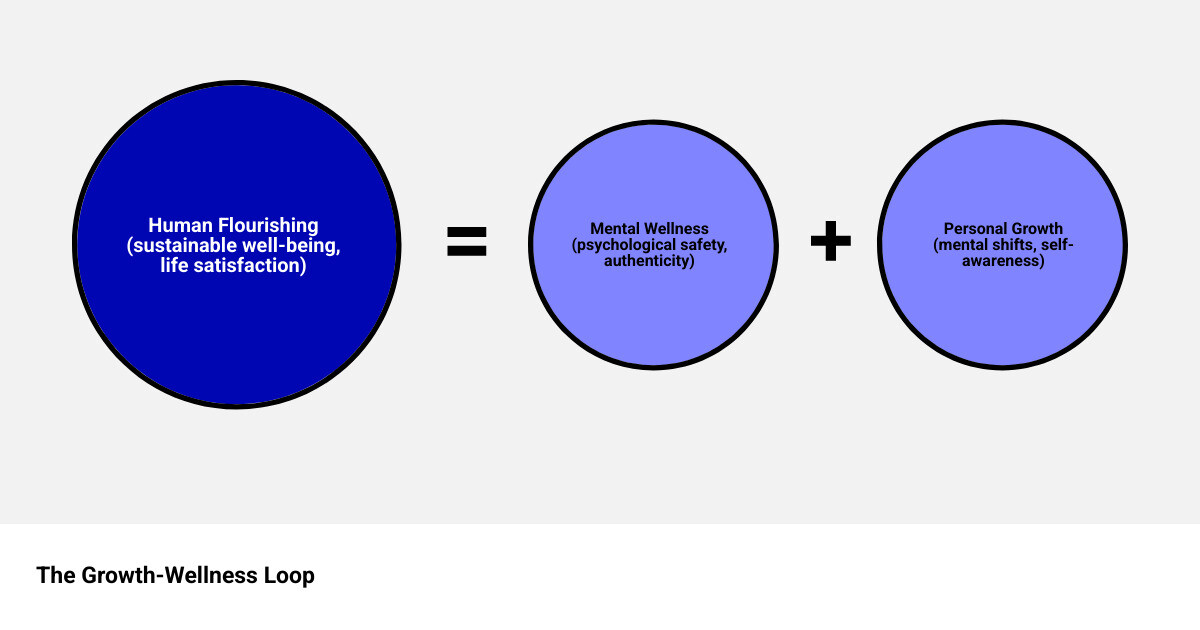
The Science of Mental Wellness and Personal Growth
Mental wellness and personal growth are not merely abstract concepts; they are deeply rooted in our psychological makeup and supported by scientific understanding. Research consistently shows that engaging in personal growth initiatives is associated with higher levels of psychological well-being and lower levels of distress, such as depression and anxiety. This isn’t surprising, as growth-oriented behaviors directly address core psychological needs:
- Autonomy: Our need to feel in control of our own lives and choices.
- Competence: Our need to feel effective and capable in our actions.
- Relatedness: Our need to feel connected and supported by others.
When these needs are met, we experience improved well-being. Personal growth, in essence, is the active pursuit of fulfilling these needs through continuous self-improvement and self-actualization. It equips us with the resilience to navigate life’s challenges, rather than removing them entirely.
The journey from languishing—a state of emotional flatness and low engagement—to flourishing, a state of optimal mental health and vitality, is often propelled by prioritizing personal growth. Individuals who actively pursue growth report using stronger coping strategies and reconnecting with their sense of purpose. This shift is powerful, transforming how we perceive and interact with the world.
A crucial foundation for this growth is psychological safety. This refers to an environment where we feel safe to be ourselves, take risks, and learn from mistakes without fear of judgment or retribution. From this secure base, we can embark on the necessary mental shifts outlined in the PGP model: cultivating self-awareness, embracing openness to new experiences, developing existential courage, asserting our autonomy, taking responsibility, practicing self-compassion, and extending compassion to others. These internal transformations lead to a deeper sense of authenticity and harmony in our lives.
For those seeking to cultivate a deeper sense of mental wellness and growth, understanding these psychological underpinnings is key. Many individuals find immense value in exploring these concepts further, sometimes with the guidance of professionals who specialize in fostering psychological well-being. For example, resources like Spark mental wellness and growth can provide structured support for individuals aiming to enhance their psychological health and embark on a journey of profound personal development. This integrated approach ensures that our growth is not just superficial but deeply embedded in our overall mental health.
Practical Strategies for Mental Wellness and Personal Growth
Understanding the theoretical frameworks is a powerful first step, but true transformation comes from putting knowledge into practice. Fortunately, there are many accessible and effective strategies we can adopt to foster both mental wellness and personal growth. One widely recognized and evidence-based approach is the NHS 5 Steps to Mental Wellbeing, which provides a simple yet profound roadmap for enhancing our psychological health:
- Connect: Building and maintaining strong relationships is fundamental to our well-being. Good social connections provide a sense of belonging, boost self-worth, and offer crucial emotional support. This isn’t just about superficial interactions; it’s about nurturing meaningful bonds with family, friends, colleagues, and community members. Whether it’s having a fixed dinner time with family, volunteering, or simply engaging in genuine conversation, these connections are vital.
- Be Active: Our physical and mental health are inextricably linked. Regular physical activity is a powerful mood booster, raising self-esteem, helping us achieve personal goals, and triggering positive chemical changes in the brain. It acts as a buffer against stress and can significantly reduce symptoms of anxiety and depression. The key is to find activities we enjoy, whether it’s a brisk walk, dancing, gardening, or a team sport, and make them a consistent part of our lives.
- Take Notice (Mindfulness): This step encourages us to be more present and aware of the moment. Mindfulness involves paying attention to our thoughts, feelings, bodily sensations, and the world around us without judgment. By practicing mindfulness, we can improve our enjoyment of life, better understand ourselves, and approach challenges with a more positive and clear perspective. Simple practices like focusing on our breath, savoring a meal, or observing nature can integrate mindfulness into our daily routines.
- Learn New Skills: Engaging in lifelong learning is a potent driver of personal growth. It doesn’t mean enrolling in formal courses or striving for qualifications; it can be anything from learning to cook a new recipe, picking up a musical instrument, mastering a DIY project, or taking on a new responsibility at work. Learning boosts our self-confidence, raises self-esteem, provides a sense of purpose, and can even create new avenues for social connection.
- Give to Others: Engaging in acts of kindness has a remarkable impact on our own mental well-being. Helping others, volunteering, or simply expressing gratitude can create positive feelings, a sense of reward, and a profound sense of purpose and self-worth. These actions connect us to our community and reinforce our shared humanity.

These five steps are not isolated practices but rather interconnected elements that, when integrated into our lives, create a virtuous cycle of improved mental wellness and accelerated personal growth. By consciously weaving these strategies into our daily existence, we build a robust foundation for a more fulfilling and resilient life.
Goal Setting as a Tool for Development
Effective goal setting is a critical component of personal development, providing direction, motivation, and a tangible way to measure progress. It transforms vague aspirations into concrete plans, empowering us to take intentional action. The widely adopted SMART goals framework offers a robust structure for setting objectives:
- Specific: Clearly define what you want to achieve.
- Measurable: Establish criteria to track your progress.
- Achievable: Ensure the goal is realistic and attainable.
- Relevant: Align the goal with your values and broader aspirations.
- Time-bound: Set a deadline to create urgency and focus.
Beyond SMART goals, models like the GROW model (Goal, Reality, Options, Way Forward) can further refine our approach, especially when working with a mentor or coach. This iterative process helps us clarify our objectives, assess our current situation, explore possibilities, and commit to actionable steps.
Progress toward goals, rather than their attainment, often offers the most personal growth and well-being. The journey itself, with its challenges and learning opportunities, is where true development occurs. This perspective allows us to celebrate small wins and maintain motivation, recognizing that each step forward contributes to our overall growth. Designing for dopamine—the brain’s reward chemical—by breaking larger goals into smaller, achievable steps helps create a sense of accomplishment and fuels intrinsic motivation. Regularly receiving feedback, whether from self-reflection or external sources, further reinforces this positive loop.
For professionals aiming for significant personal and career milestones, understanding how to set and achieve impactful goals is paramount. This can be particularly true in leadership roles where strategic planning and execution are key. For instance, an individual focused on Executive growth with CMO might utilize these goal-setting principles to navigate complex career transitions, develop leadership skills, or launch new ventures. The structured approach to goal setting, coupled with a focus on consistent progress and internal motivation, serves as a powerful engine for sustained personal and professional development.
Internal Drivers: Mindset and Self-Awareness
While external strategies provide a roadmap, the internal landscape of our minds plays an equally critical role in our journey toward mental wellness and personal growth. Two powerful internal drivers are our mindset and our level of self-awareness.
At the heart of sustained personal growth is a growth mindset, a concept popularized by psychologist Carol Dweck. Individuals with a growth mindset believe that their abilities and intelligence can be developed through dedication and hard work. They embrace challenges as opportunities to learn, view setbacks as stepping stones, and are inspired by the success of others. This contrasts sharply with a fixed mindset, where abilities are seen as static and unchangeable. Cultivating a growth mindset allows us to continually evolve, learn from experiences, and develop our strengths, realizing our fullest potential. It transforms our relationship with failure, turning it into valuable feedback rather than a definitive end.
Equally vital is self-awareness, the ability to understand our own emotions, thoughts, values, strengths, and weaknesses. It’s the foundation upon which all other personal development is built. Without self-awareness, we operate on autopilot, reacting impulsively rather than responding thoughtfully. Becoming more self-aware allows us to identify areas for improvement, make informed decisions that align with our values, and ultimately choose intentional responses over automatic reactions. This heightened awareness is also a cornerstone of emotional intelligence, enabling us to better manage our own emotions and empathize with others.
Part of developing self-awareness involves recognizing and leveraging our signature strengths. These are our innate positive traits and capacities that feel authentic and energizing to use. Tools like the VIA Character Strengths Survey (often referred to as the VIA test) can help us identify these unique attributes. Once identified, the “aware-explore-apply” model suggests we become aware of our strengths, explore how they manifest in different areas of our lives, and then consciously apply them to enhance our well-being and achieve our goals. For example, if “curiosity” is a signature strength, we might actively seek out new learning opportunities or explore different perspectives to solve problems.
Practices such as journaling, meditation, and self-reflection questions are excellent ways to deepen self-awareness. Taking time to process our experiences, understand our emotional patterns, and clarify our values helps us to align our actions with our authentic selves.
By consciously nurturing a growth mindset and consistently enhancing our self-awareness, we unlock immense internal power. These drivers empower us to navigate life’s complexities with greater resilience, make choices that truly serve our well-being, and continually progress on our unique path of personal growth.
Overcoming Obstacles and Building Resilience
The path to mental wellness and personal growth is rarely linear; it’s often marked by challenges, setbacks, and moments of doubt. Learning to effectively navigate these obstacles and build resilience is crucial for sustained progress.
One highly effective therapeutic approach that supports personal growth, particularly in overcoming mental health challenges, is Cognitive Behavioral Therapy (CBT). Widely recognized as the ‘gold standard’ for treating depression, anxiety disorders, and post-traumatic stress disorder, CBT helps individuals identify and change negative thought patterns and behaviors that contribute to distress. By reframing distorted thinking and developing healthier coping mechanisms, CBT empowers us to approach difficulties with a more constructive outlook, directly supporting our capacity for growth.
Beyond formal therapy, cultivating self-compassion is an indispensable tool for building resilience. Instead of harshly criticizing ourselves during setbacks, self-compassion involves treating ourselves with the same kindness and understanding we would offer a dear friend. This practice is essential for breaking vicious cycles of self-blame and negative coping mechanisms. When we are compassionate towards ourselves, we are better able to learn from mistakes, prioritize our well-being, and re-engage in virtuous cycles of positive action and growth.
Understanding the dynamics of vicious cycles versus virtuous cycles is also key. Vicious cycles are often fueled by negative perceptions of uncontrollable life events, leading to harmful habits like emotional numbing (e.g., excessive alcohol use, overeating, or binge-watching). These patterns keep us stuck. In contrast, virtuous cycles emerge from compassionate reframing, where we choose to see challenges as opportunities. Small, consistent actions, often referred to as habit-stacking, can create powerful momentum in these positive spirals.
A powerful technique for dealing with uncontrollable circumstances is radical acceptance. This involves acknowledging situations exactly as they are, without judgment or resistance. It’s not about condoning or liking the situation, but about accepting its reality, which frees up mental and emotional energy to focus on what we can control – our response and our path forward. This practice is a cornerstone of resilience, allowing us to adapt and move forward even when faced with adversity.
Resilience itself is the ability to bounce back from difficulty, often emerging stronger than before. It involves not just enduring hardship but also using positive emotions and coping strategies to adapt. By integrating self-compassion, recognizing emotional patterns, and connecting to our core personal values, we can build a robust capacity for resilience. This allows us to view setbacks not as failures, but as integral parts of our ongoing growth journey.
By embracing these strategies – from evidence-based therapeutic approaches like CBT to the foundational practices of self-compassion and radical acceptance – we equip ourselves to overcome common challenges and cultivate an unshakeable inner strength, ensuring our mental wellness and personal growth continue to flourish.
Sustaining Mental Wellness and Personal Growth Through Habits
The adage “we are what we repeatedly do” holds profound truth when it comes to mental wellness and personal growth. Sustainable progress isn’t about grand gestures but about the consistent cultivation of positive daily habits. This is where the power of “tiny habits” and “habit stacking” comes into play. Instead of aiming for drastic changes, we focus on implementing small, manageable actions that, over time, build significant momentum. For example, instead of resolving to meditate for an hour, we might start with just one minute, building on that success. Habit stacking involves linking a new desired habit to an existing one, making it easier to remember and integrate.
The “60-day rule,” while not a strict scientific dictum, highlights the time and consistency often required for new behaviors to become ingrained. It suggests that around two months of consistent effort can solidify a new habit. This emphasizes the importance of patience and persistence on our growth journey.
Regularly assessing our well-being and progress is also crucial for sustaining momentum. Tools like the PERMA-Profiler can help us identify unique well-being dimensions and track our growth in areas like positive emotions, engagement, relationships, meaning, and accomplishment. This allows for targeted personal development and helps us recognize where we are thriving and where we might need to adjust our focus.
Celebrating wins, no matter how small, is a vital practice for long-term vitality. Acknowledging our progress releases dopamine, reinforcing positive behaviors and boosting motivation. This creates a positive feedback loop that encourages continued effort.
Sustaining mental health and personal development relies on a holistic approach to self-care routines. This includes adequate sleep, nourishing food, regular physical activity, mindful breaks, and protecting our emotional boundaries. These practices aren’t luxuries; they are non-negotiable foundations for a life of flourishing. By consistently nurturing these habits, we ensure that our journey of mental wellness and personal growth is not just a temporary sprint but a lifelong, enriching marathon.
Frequently Asked Questions about Personal Development
As we embark on or continue our journey of mental wellness and personal growth, it’s natural to have questions. Here, we address some common inquiries to provide further clarity and guidance.
How long does it take to see real change in my mental well-being?
The timeline for seeing real change in mental well-being and personal growth is highly individual, but research offers some helpful insights. When it comes to habit formation, studies suggest it can take two months or even longer for new behaviors to become automatic. The more complex or difficult the change, the more time and consistent effort it typically requires.
It’s crucial to prioritize consistency over intensity. Small, incremental progress each day is far more effective than sporadic, overwhelming efforts. Even tiny habits, consistently practiced, build powerful momentum over time. Focus on showing up for yourself daily, even if it’s just for five minutes of mindfulness or a short walk. You might start noticing subtle shifts in your mood, perspective, and energy within a few weeks, with more significant, lasting changes becoming apparent over several months of dedicated practice. This is a marathon, not a sprint.
Is personal growth possible during a mental health crisis?
Yes, personal growth is absolutely possible during a mental health crisis, though it often looks different than during periods of stability. In fact, navigating a crisis can be a profound catalyst for growth, fostering immense resilience. During such times, the focus shifts from achieving external goals to internal healing and stabilization.
Key strategies include seeking professional support from therapists, counselors, or psychiatrists, who can provide essential tools and guidance. Therapeutic approaches like CBT can be instrumental in managing symptoms and developing coping mechanisms. Practicing radical acceptance and self-compassion becomes paramount, allowing us to be kind to ourselves during immense struggle. Focusing on small wins—like getting out of bed, eating a nutritious meal, or reaching out to a supportive friend—can build a sense of agency and hope. While the journey is challenging, the insights gained, the coping skills developed, and the inner strength discovered during a crisis can lead to deep, transformative personal growth.
What is the difference between self-help and personal growth?
While often used interchangeably, there’s a nuanced distinction between self-help and personal growth. Self-help often refers to a broad category of resources—books, seminars, motivational talks—designed to provide inspiration, quick fixes, or immediate solutions to specific problems. It can be a great starting point for motivation and new ideas.
Personal growth, on the other hand, is a deeper, more intentional, and continuous process of self-improvement. It’s less about temporary inspiration and more about sustained skill-building, introspection, and a commitment to lifelong evolution. Personal growth focuses on developing core competencies like self-awareness, emotional regulation, communication skills, and problem-solving. It’s rooted in evidence-based models and consistent practice, emphasizing how we thoughtfully respond to challenges rather than just changing who we are. It’s about understanding our values, clarifying our goals, and making intentional choices that align with our authentic self, leading to profound, long-term transformation rather than just a momentary boost.
Conclusion
As we reflect on the pathways to mental wellness and personal growth, it becomes clear that these are not destinations but continuous, evolving journeys. Our exploration, from the foundational models of PERMA and Maslow’s hierarchy to practical strategies and internal drivers, underscores a fundamental truth: a flourishing life is built on intentional effort and a deep commitment to ourselves.
The pursuit of personal growth profoundly impacts our sense of purpose and overall life satisfaction. Research consistently demonstrates that individuals with a defined purpose experience a multitude of benefits, including longer lives, improved sleep, more robust immune systems, lower stress levels, and better cognitive function. This intrinsic motivation to grow, to connect with something larger than ourselves, is a powerful engine for vitality.
Looking ahead to April 2026 and beyond, we recognize that these are non-linear journeys. There will be peaks and valleys, moments of rapid advancement and periods of quiet introspection. The key is not to strive for perfection, but for consistent progress, self-compassion, and an unwavering belief in our capacity to evolve.
Embracing mental wellness and personal growth means committing to a life of continuous learning, meaningful connections, and authentic living. It means bravely facing challenges, developing resilience, and harnessing the power of our mindset and self-awareness. We encourage you to take these insights and integrate them into your daily life, crafting a blueprint for your own unique path to flourishing. The journey is yours to define, and every step forward, no matter how small, contributes to a richer, more fulfilling existence.


