
Achieving Results with Behavior-Based Dog Training
With five dogs, four of them huskies with plenty of opinions, behavior-based dog training isn’t theoretical for me, it’s something I’ve had to actually apply. The distinction between normal-but-undesirable behaviors and true behavioral disorders really clarified something I’ve wondered about for years, since a husky’s digging and howling always felt more like breed instinct than a problem to fix. Reading through why aversive methods backfire long-term reinforced everything I’ve learned from trial and error with our own pack, positive reinforcement genuinely builds a better relationship, not just faster compliance.
Introduction

We all cherish the idea of a happy, well-behaved canine companion. However, behavioral challenges are common and can create stress for both dogs and their human families. In fact, behavioral problems are a leading reason why pets are surrendered to shelters. But it doesn’t have to be this way.
We understand that addressing these issues requires more than just basic obedience. It demands a deep dive into the science of how dogs learn and behave.
This extensive guide will help you navigate the complexities of dog behavior training. We will explore effective, science-based methods to modify common problems like aggression, anxiety, and excessive barking. We’ll also cover how to find qualified trainers, understand the role of veterinary behaviorists, and distinguish between normal behaviors and true disorders.
Effective dog behavior training is rarely a one-size-fits-all approach. We advocate for tailored solutions that address the unique needs of each dog and owner, ensuring successful outcomes. For a comprehensive overview of how to achieve such tailored results, you might find this guide on personalized dog training helpful.
Join us as we uncover practical steps, best practices, and essential resources to build a stronger, more harmonious relationship with your beloved dog.
Core Principles of Professional Dog Training and Behavior Modification
At the heart of effective dog behavior training lies a scientific understanding of how animals learn. This foundation is built upon principles like operant conditioning, classical conditioning, and stimulus control, all applied through carefully designed reinforcement schedules. Professional dog trainers and veterinary behaviorists leverage these concepts to modify behavior in a humane and lasting way.
Operant conditioning focuses on how consequences influence voluntary behaviors. When a dog performs an action, the outcome (reinforcement or punishment) determines whether that behavior is more or less likely to occur again. Positive reinforcement, which involves adding something desirable (like a treat or praise) after a desired behavior, is the cornerstone of modern, ethical training. Classical conditioning, on the other hand, deals with involuntary responses, associating a neutral stimulus with a meaningful one. For example, a dog might learn to associate the sound of a clicker with receiving a treat, eventually eliciting a positive emotional response to the clicker alone.
Stimulus control refers to a behavior occurring reliably in the presence of a specific cue or situation, but not others. This is how we teach a dog to “sit” only when given the command, not randomly. Reinforcement schedules dictate how often and when reinforcement is delivered, influencing the strength and persistence of a behavior.
Beyond these learning theories, techniques like response substitution are crucial. This involves teaching a dog an alternative, desirable behavior to perform instead of an unwanted one (e.g., teaching a dog to sit for greetings instead of jumping). Environmental management plays a vital role by proactively altering the dog’s surroundings to prevent unwanted behaviors from occurring in the first place, or to reduce exposure to triggers. By understanding and applying these core principles, we can effectively address a wide spectrum of canine behaviors.
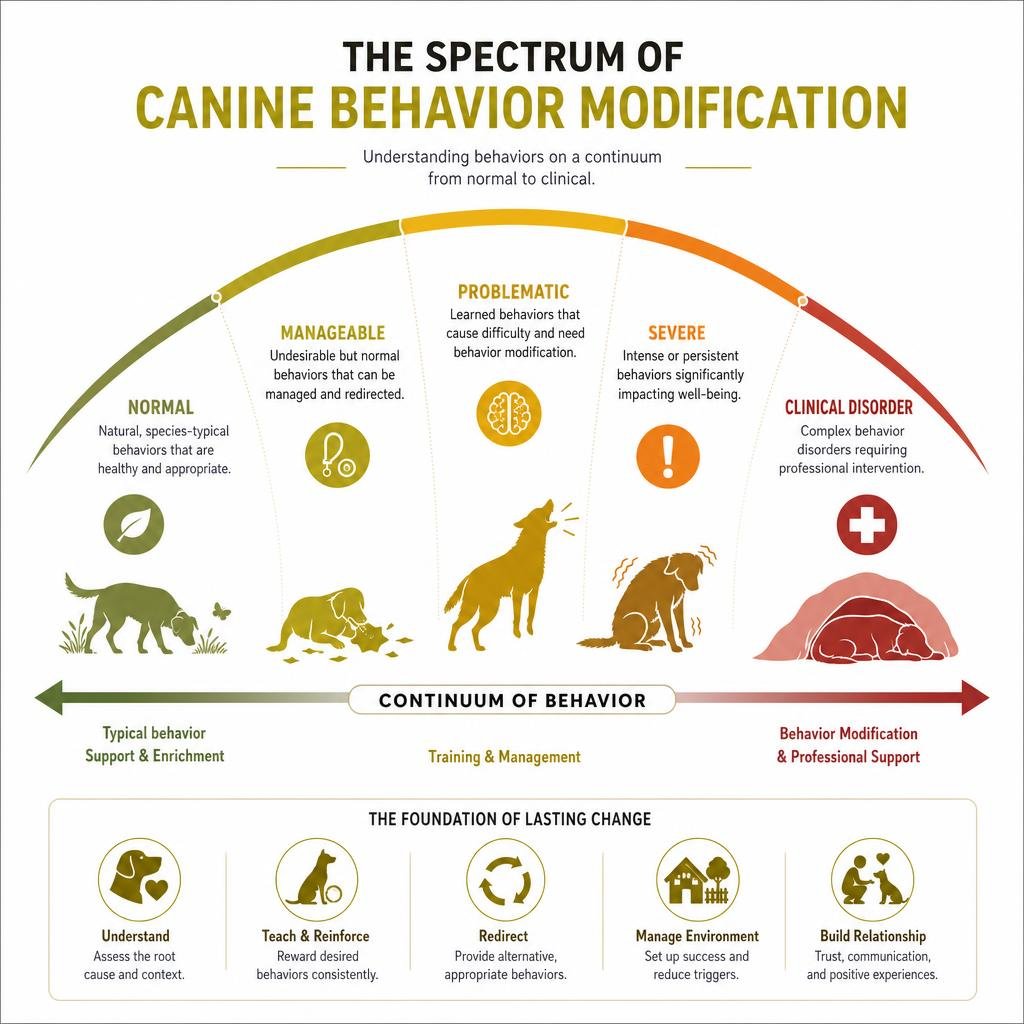
Differentiating Normal Behaviors from True Behavior Disorders
Understanding the difference between normal, albeit undesirable, canine behaviors and true behavior disorders is critical for effective intervention. Many behaviors that owners find challenging are actually species-typical behaviors – natural actions that dogs perform. These can include attention barking, exploratory chewing, digging, or even appropriate play biting in puppies. While these behaviors might be inconvenient or destructive in a human home, they are not inherently abnormal. They can usually be managed and redirected through consistent training, environmental enrichment, and appropriate outlets for natural instincts. For instance, a dog chewing furniture might simply need more appropriate chew toys and mental stimulation.
True behavior disorders, however, are more complex. These are often characterized by extreme, persistent, or maladaptive responses that significantly impact a dog’s welfare and quality of life. Examples include severe separation anxiety, which manifests as intense distress, destruction, or vocalization when alone; compulsive disorders, where a dog performs repetitive, seemingly purposeless actions like tail-chasing or flank-sucking; or intense noise phobias, where a dog exhibits extreme fear and panic in response to specific sounds like thunderstorms or fireworks. These disorders often have underlying emotional components, such as fear, anxiety, or stress, and may require a multi-faceted approach involving behavior modification, environmental changes, and potentially veterinary intervention. Recognizing this distinction helps owners seek the most appropriate and effective help.
Normal but Undesirable Behaviors True Behavioral Disorders Puppy nipping/play biting Fear-related aggression Attention-seeking barking Separation anxiety Exploratory chewing Compulsive disorders Digging in the yard Severe noise phobias Jumping on guests Generalized anxiety House soiling (due to lack of training) Elimination due to medical conditions or extreme stress Evidence-Based Techniques: Desensitization, Counterconditioning, and Shaping

When addressing specific fears, anxieties, or phobias in dogs, evidence-based techniques like desensitization, counterconditioning, and shaping are invaluable. These methods are designed to gradually change a dog’s emotional response and behavior towards a trigger, rather than suppressing it through force.
Systematic Desensitization involves gradually exposing a dog to a feared stimulus at such a low level that it does not elicit a fear response. The intensity is then slowly increased over many sessions, ensuring the dog remains calm and below its emotional threshold. For example, a dog fearful of loud noises might first be exposed to a barely audible recording of that sound, paired with positive experiences. The volume is incrementally increased only when the dog shows no signs of anxiety at the current level. The goal is to habituate the dog to the stimulus without causing distress.
Classical Counterconditioning works hand-in-hand with desensitization. It involves changing a dog’s negative emotional association with a trigger to a positive one. While desensitizing, we pair the low-level trigger with something the dog loves, like high-value treats or praise. If a dog fears strangers, we might offer treats every time a stranger appears at a safe distance, aiming to create a new association: “stranger = yummy food” instead of “stranger = scary.” This transforms the dog’s emotional response from fear to anticipation of something good.
Shaping is a technique used to teach new behaviors or refine existing ones by reinforcing successive approximations of the desired action. Instead of waiting for the dog to perform the perfect behavior, we reward small steps in the right direction. For instance, to teach a dog to touch a target, we might first reward looking at the target, then moving towards it, then sniffing it, and finally touching it with their nose. This builds confidence and allows the dog to “discover” the desired behavior through positive reinforcement.
Understanding concepts like overlearning, where a behavior is practiced so extensively it becomes automatic, and being aware of extinction bursts (a temporary increase in an unwanted behavior when reinforcement is removed) and spontaneous recovery (the reappearance of a previously extinguished behavior) are also crucial for trainers and owners. These insights help us manage expectations and persist with consistent, humane training plans.
The Science of Reinforcement vs. Aversive Methods
The debate between different dog training methodologies has evolved significantly over the years, with a strong consensus now forming around reward-based training. This approach, grounded in welfare science and learning theory, prioritizes positive reinforcement, animal agency, and non-confrontational methods. It aligns with what is known as the “humane hierarchy” of intervention, which advocates for the least intrusive, minimally aversive approach to behavior modification.
Positive reinforcement involves adding something desirable to increase the likelihood of a behavior repeating. This could be food, praise, toys, or access to preferred activities. This method builds a strong, trusting relationship between dog and owner, as the dog associates training with positive experiences. It empowers the dog to make choices that lead to rewards, fostering a sense of agency and engagement. We see dogs trained with these methods often exhibiting greater confidence and enthusiasm for learning.
In contrast, aversive methods, which include punishment-based or dominance-focused techniques, rely on physical or psychological discomfort to suppress unwanted behaviors. These can involve tools like prong collars, choke chains, electronic shock collars, or techniques such as alpha rolls, scolding, or physical corrections. While these methods might achieve a quick suppression of behavior, the scientific evidence overwhelmingly points to their significant risks and drawbacks. Studies consistently show that training based on punishments or confrontations are more likely to lead to fear, avoidance, and increased aggression, while dogs trained with rewards have fewer behavioral problems and are less fearful.
Behavioral Fallout, Stress Markers, and Cognitive Bias
The use of aversive training methods often leads to significant behavioral fallout, negatively impacting a dog’s emotional well-being and the human-animal bond. When dogs are subjected to pain, fear, or intimidation, they exhibit physiological stress responses, including elevated cortisol levels. While cortisol increases can occur during positive arousal, sustained high levels indicate distress. Dogs trained with aversive methods often display acute stress behaviors such as lip-licking, yawning, panting, lowered body posture, and avoidance.
Beyond these immediate signs, long-term consequences can include learned helplessness, where a dog ceases to respond or initiate behaviors because it has learned that its actions have no predictable effect on its environment or that any action might result in punishment. This can manifest as a general lack of enthusiasm or a “shut down” demeanor. Research has also indicated that dogs trained with aversive methods show a higher cognitive bias towards “pessimism,” meaning they are more likely to anticipate negative outcomes, impacting their overall quality of life.
The outdated concept of “dominance” or “alpha” theory, which suggests that humans must assert physical dominance over their dogs, has been thoroughly debunked by animal behavior scientists. Applying these theories through confrontational methods can severely damage a dog’s trust and increase the likelihood of fear-related aggression. We know that aggression is the most common behavior problem in dogs, accounting for approximately 70% of the caseload in referral practices across North America. Using aversive methods to address aggression can escalate the problem, making the dog more reactive and potentially dangerous. Therefore, we strongly advocate for exclusively reward-based approaches that prioritize the dog’s welfare and foster a positive learning environment.
Designing Structured Routines and Cue-Response-Reward Systems
Creating a structured environment and routine is one of the most practical and effective steps owners can take to reduce anxiety and improve their dog’s overall behavior. Dogs thrive on predictability. A consistent daily schedule helps them understand what to expect, reducing uncertainty and the stress that often accompanies it. This includes regular feeding times, potty breaks, exercise, and training sessions.
Environmental predictability is key. This involves more than just a schedule; it’s about managing the dog’s surroundings through antecedent arrangement. This means setting up the environment to prevent unwanted behaviors and encourage desirable ones. For example, if a dog chews furniture, removing access to furniture when unsupervised and providing appropriate chew toys is antecedent arrangement. Similarly, creating designated “safe havens” – quiet, comfortable spaces where a dog can retreat when feeling overwhelmed – can significantly reduce anxiety.
A cue-response-reward system is fundamental to teaching and reinforcing desired behaviors within this structure. We give a cue (e.g., “sit”), the dog performs the response (sits), and we immediately follow with a reward (treat, praise). This clear communication builds self-control protocols, where the dog learns that performing specific actions leads to positive outcomes.
Trigger tracking, which involves identifying and monitoring situations or stimuli that cause a dog stress or unwanted behaviors, allows owners to proactively manage the environment. For example, if a dog barks excessively at passersby, managing visual access to windows can reduce the trigger.
Here are some environmental enrichment strategies that can be integrated into a structured routine to enhance a dog’s well-being and reduce anxiety:
- Puzzle Toys and Food Dispensers: Provide mental stimulation and make mealtime engaging.
- Chew Toys: Offer appropriate outlets for natural chewing instincts, preventing destructive chewing.
- Regular Exercise: Ensure adequate physical activity tailored to the dog’s breed and age.
- Interactive Play: Engage in games like fetch or tug to strengthen the bond and provide an outlet for energy.
- Training Sessions: Short, positive training sessions provide mental exercise and reinforce good behavior.
- Safe Spaces: Designate a crate or quiet room as a comfortable retreat.
- Sensory Enrichment: Use dog-specific music, calming scents, or varied textures to stimulate senses positively.
- Social Interaction: Provide appropriate and supervised interaction with other dogs or people, if the dog enjoys it.
By combining a predictable routine with thoughtful environmental management and consistent reward-based training, we empower dogs to feel more secure, confident, and well-behaved.
Managing Complex Issues: Aggression, Anxiety, and Phobias
Addressing complex behavioral issues such as aggression, anxiety, and phobias requires a comprehensive and careful approach. These problems are often rooted in deep-seated emotional responses and can pose significant safety concerns. Our primary goals are always to ensure safety, reduce the dog’s stress, and teach them more appropriate ways to cope. This often involves a detailed behavior modification plan, focusing on bite prevention, identifying stress triggers, respecting emotional thresholds, and implementing safety barriers.
Aggression, in particular, demands extreme caution, as at least 5 million people are referred to the hospital each year in the US alone for treatment of dog bites. Aggression is almost always fear-based, territorial, or possessive, rather than a desire to “dominate.”

Safe Protocols for Resource Guarding and Fear-Based Aggression
When dealing with specific forms of aggression like possessive aggression (resource guarding) or fear-related aggression, safety is paramount. Resource guarding occurs when a dog protects items (food, toys, resting spots, people) from perceived threats. Fear-related aggression stems from a dog feeling threatened and using aggression as a defense mechanism. Territorial aggression involves protecting a specific area.
For resource guarding, we avoid direct confrontation. Instead, we use techniques like “trade games,” where we offer a higher-value item in exchange for the guarded item, teaching the dog that giving things up leads to better outcomes. We also practice distance management, ensuring people and other pets stay far enough away from the guarded resource to prevent a reaction.
For fear-related aggression and territorial aggression, the focus is on managing the environment to prevent exposure to triggers and then gradually changing the dog’s emotional response. This often involves:
- Trigger Avoidance: Initially, we prevent the dog from encountering situations that elicit aggression.
- Distance Management: We work with the dog at a distance from the trigger where they remain calm and below their emotional threshold.
- Counterconditioning and Desensitization: As discussed earlier, we pair the trigger (at a low intensity) with positive experiences, gradually increasing intensity over time.
- Safety Barriers: Using leashes, crates, gates, or muzzles can provide crucial safety measures during the modification process, allowing us to work safely while preventing bites.
- Body Language Recognition: Owners learn to recognize subtle signs of stress or fear in their dog’s body language to intervene before aggression escalates.
It is vital to remember that managing aggression is a long-term commitment and often requires professional guidance to ensure safety and effectiveness.
When to Integrate Veterinary Behaviorists with Professional Dog Training
While qualified professional dog trainers can address many behavioral issues, there are instances where the expertise of a veterinary behaviorist becomes essential. Veterinary behaviorists are veterinarians who have completed specialized training and certification in animal behavior, making them uniquely qualified to diagnose and treat behavioral disorders from both a medical and behavioral perspective.
We strongly recommend considering a veterinary behaviorist when:
- Behavioral issues are severe or persistent: Especially cases involving aggression, severe anxiety, or phobias that haven’t responded to conventional training.
- There’s a suspicion of underlying medical conditions: Many behavioral problems can be caused or exacerbated by pain or illness. A veterinary behaviorist can perform a thorough medical rule-out, including pain assessment, to identify and address any physiological contributions. Clinical research shows that between 28% and 82% of dogs evaluated by veterinary behaviorists show signs of underlying pain contributing to their behavior problems.
- Medication might be beneficial: Veterinary behaviorists can prescribe psychopharmacology (behavioral medications) to help manage severe anxiety, fear, or compulsive disorders. These medications, such as SSRIs (Selective Serotonin Reuptake Inhibitors) as maintenance medications or situational anxiolytics, are not a magic bullet but are most effective when combined with a structured behavior modification plan. They can help reduce a dog’s emotional arousal, making them more receptive to learning and training.
Integrating a veterinary behaviorist ensures a holistic approach, addressing both the behavioral and physiological aspects of a dog’s condition, leading to more comprehensive and lasting solutions.
Selecting the Right Approach and Professional for Your Dog
Choosing the right professional to guide you and your dog through behavioral challenges is one of the most critical decisions you’ll make. The field of dog training is largely unregulated, meaning anyone can call themselves a “dog trainer.” Therefore, it’s essential for owners to be informed consumers, seeking out trainers who adhere to a high standard of care, humane practices, and evidence-based methods. We believe in owner coaching, empowering you with the knowledge and skills to understand and effectively communicate with your dog.
Evaluating Credentials and Standards in Professional Dog Training
When selecting a dog trainer, prioritize those with professional certifications from reputable organizations. Look for certifications such as Certified Professional Dog Trainer (CPDT-KA), Certified Behavior Consultant Canine (CBCC-KA), or those affiliated with the Karen Pryor Academy (KPA-CTP) or the International Association of Animal Behavior Consultants (IAABC). These certifications indicate that the trainer has met rigorous standards of knowledge and practical skill, often requiring continuing education.
Crucially, inquire about their training ethics and methodology. A qualified trainer should exclusively use force-free, positive reinforcement methods. They should be able to clearly explain their techniques and how they work. Red flags include trainers who:
- Use or recommend aversive tools like prong collars, choke chains, or electronic shock collars.
- Employ dominance theory or physical corrections.
- Offer “guarantees” of results, as behavior is complex and influenced by many factors.
- Discourage owners from observing classes or asking questions.
The animal care and service industry, which includes animal trainers, is expected to grow at 15% over the next decade, highlighting the increasing demand for skilled professionals. We recommend observing a trainer’s class without your dog first to ensure their methods align with your values and the welfare of your pet. A good trainer will also prioritize client education, teaching you how to understand your dog’s body language and continue the training process effectively at home.
Early Puppy Socialization and Habituation Protocols
Preventing behavior problems starts early, specifically during puppyhood. The critical socialization period in puppies occurs between 3 and 12 weeks of age. This sensitive period is a crucial window for puppies to learn about the world and develop into well-adjusted adult dogs.
Primary socialization involves carefully exposing puppies to a wide variety of positive experiences with people, other friendly dogs, and different environments. This helps them build confidence and resilience. We aim for controlled, positive interactions rather than overwhelming the puppy.
Environmental habituation means exposing puppies to novel stimuli – different sights, sounds, textures, and smells – in a non-threatening way. This could include car rides, vacuum cleaners, different floor surfaces, or people wearing hats. The goal is for the puppy to learn that these things are normal and not scary.
Key steps for puppy prevention protocols include:
- Puppy Classes: Enroll in well-run, positive-reinforcement-based puppy classes. These provide safe socialization opportunities and teach basic manners.
- Controlled Exposure: Gradually introduce new experiences, ensuring they are always positive and never overwhelming.
- Handling Exercises: Regularly handle your puppy’s paws, ears, mouth, and tail to get them comfortable with touch, which helps with vet visits and grooming.
- Bite Inhibition: Teach your puppy to control the force of their bite through appropriate play and redirection to chew toys.
- Early Crate Training: Introduce a crate as a safe, comfortable den.
- Positive Reinforcement: Consistently reward calm, confident behavior in new situations.
By investing in proper socialization and habituation during this critical period, we can help puppies develop into resilient, well-behaved companions, significantly reducing the likelihood of future behavioral issues.
Frequently Asked Questions about Dog Behavior Training
How does physical pain influence behavioral problems in dogs?
Physical pain can be a major contributing factor to a wide range of behavioral problems in dogs, often leading to aggression, anxiety, or reluctance to perform certain actions. When a dog is in pain, its tolerance for stimuli decreases, and it may lash out defensively, especially if touched in a sensitive area. This can manifest as pain-induced aggression, where a dog snaps or bites when approached or handled. Clinical studies have shown that a significant percentage of dogs presenting with behavioral issues, ranging from 28% to 82% in some veterinary behaviorist caseloads, have underlying medical conditions or orthopedic pain contributing to their behavior. Therefore, a thorough veterinary screening and medical diagnostics are always recommended as a first step when a dog exhibits sudden or unexplained behavioral changes. Addressing the underlying pain can often alleviate or resolve the associated behavioral issues, making behavior modification much more effective.
Why is flooding discouraged in canine behavior modification?
Flooding is a behavior modification technique that involves prolonged, inescapable exposure to a high-intensity feared stimulus until the dog’s fear response supposedly extinguishes. However, flooding is widely discouraged by veterinary behaviorists and ethical trainers due to its severe risks and negative welfare implications. Instead of resolving fear, flooding often leads to sensitization, where the dog’s fear actually worsens, or can result in learned helplessness, where the dog “shuts down” emotionally but remains terrified internally. This can cause significant emotional trauma, damage the human-animal bond, and potentially escalate aggression. Ethical welfare standards dictate that we should always prioritize the dog’s emotional well-being, using gradual, positive methods like desensitization and counterconditioning that keep the dog below its emotional threshold.
How long does behavioral medication take to show noticeable results?
The timeline for behavioral medication to show noticeable results in dogs can vary significantly depending on the specific drug, the individual dog, and the nature of the behavioral issue. For selective serotonin reuptake inhibitors (SSRIs), which are commonly prescribed for anxiety and fear-related disorders, it may take 3 to 4 weeks before noticeable effects on behavior become apparent. This is because these medications work by gradually altering brain chemistry. Other medications, such as situational anxiolytics (e.g., trazodone or gabapentin), may have a faster onset of action, sometimes within hours, and are used for acute stress events. Medication is rarely a standalone solution; it works best in synergy with a comprehensive behavior modification plan. Owners should work closely with their veterinary behaviorist or veterinarian for proper psychotropic monitoring, dosage adjustments, and to understand the therapeutic window for their dog’s specific treatment.
Conclusion
Navigating dog behavior training can seem daunting, but with an understanding of evidence-based methodology, owners can achieve remarkable results. We have explored the fundamental principles of learning theory, the crucial distinction between normal behaviors and true disorders, and the power of humane techniques like desensitization, counterconditioning, and shaping. We’ve also highlighted the significant risks of aversive methods and the profound benefits of reward-based training for a dog’s long-term welfare and the human-animal bond.
By creating structured environments, implementing consistent routines, and understanding when to seek specialized help from veterinary behaviorists, we can address even the most complex issues like aggression and severe anxiety. Early puppy socialization remains a cornerstone of prevention, building resilient and well-adjusted companions from the start.
Effective dog behavior training is about clear, consistent communication, empathy, and a commitment to positive reinforcement. By applying these principles, we not only resolve behavioral challenges but also strengthen the loving bond we share with our canine family members, leading to a happier, more harmonious life for everyone.


