
A Guide to Heat Pump and Mini-Split Installation
Living somewhere with real humid summers, and a house full of kids and animals that seems to generate its own weather system indoors, I have definitely experienced that “cold but clammy” feeling this piece describes without ever understanding why cranking the AC lower didn’t actually fix it. Reading through how an oversized system can short-cycle and satisfy the temperature without properly removing moisture explained a lot about a few uncomfortable nights we chalked up to “just humid weather” when it might have actually been a sizing problem the whole time.
Understanding Heat Pump and Mini-Split Systems in High-Humidity Climates
In regions characterized by high humidity, such as many coastal and subtropical areas, the primary challenge for air conditioning systems extends beyond mere temperature reduction. A significant portion of the cooling load is dedicated to removing moisture from the air, a process known as latent heat removal. When we talk about the total heat an AC system must handle, we consider both sensible heat (the heat that affects temperature) and latent heat (the heat associated with moisture content). In a typical scenario, a cooling system might handle a 75% sensible to 25% latent heat ratio. However, in high-humidity environments, this latent load can increase substantially, demanding more from the system.
Heat pumps and mini-split systems, particularly those with variable-speed blowers, are uniquely positioned to manage this challenge. Unlike older, single-speed AC units that often short-cycle, variable-speed technology allows these systems to run for longer durations at lower capacities. This extended, gentler operation is crucial for effective dehumidification. As air passes over the evaporator coil, its temperature drops below the dew point, causing moisture to condense and drain away. The longer the coil remains cold and active, the more moisture it can extract from the air. This continuous moisture removal is essential for maintaining a comfortable relative humidity (RH) level indoors, ideally below 50%, which helps prevent dust mite proliferation and mold growth. Without effective latent load removal, even if the temperature feels cool, the air can still feel clammy and uncomfortable.
Psychrometric Principles in Heat Pump Operation
To truly grasp how heat pumps and mini-splits tackle humidity, we must delve into psychrometric principles. Psychrometrics is the study of the thermodynamic properties of moist air. When we evaluate system performance, especially in humid climates, the enthalpy calculation becomes critical. Enthalpy represents the total energy in the air, encompassing both sensible and latent heat. A system’s capacity to reduce enthalpy directly correlates with its ability to cool and dehumidify.
The evaporator coil’s temperature plays a pivotal role in moisture condensation. For effective dehumidification, the coil surface must be cold enough to bring the air’s temperature below its dew point. If the coil temperature is too high, or if airflow is too rapid, moisture won’t condense efficiently. Once condensed, this moisture forms liquid water, which must be effectively collected and drained away. Proper condensate drainage is paramount to prevent water accumulation, which can lead to microbial growth and system inefficiencies. Furthermore, maintaining surface relative humidity below 75-80% on internal building materials, including duct surfaces, is critical to prevent mold growth, even if the ambient air humidity is controlled. This highlights the interconnectedness of system operation, building materials, and effective moisture management.
Ductwork Design Constraints vs. Ductless Flexibility
The choice between ducted and ductless systems, or a hybrid approach, significantly impacts how effectively a heat pump or mini-split manages humidity. Traditional ducted systems, while providing whole-home conditioning, introduce several potential points of failure for humidity control, especially in hot, humid climates.
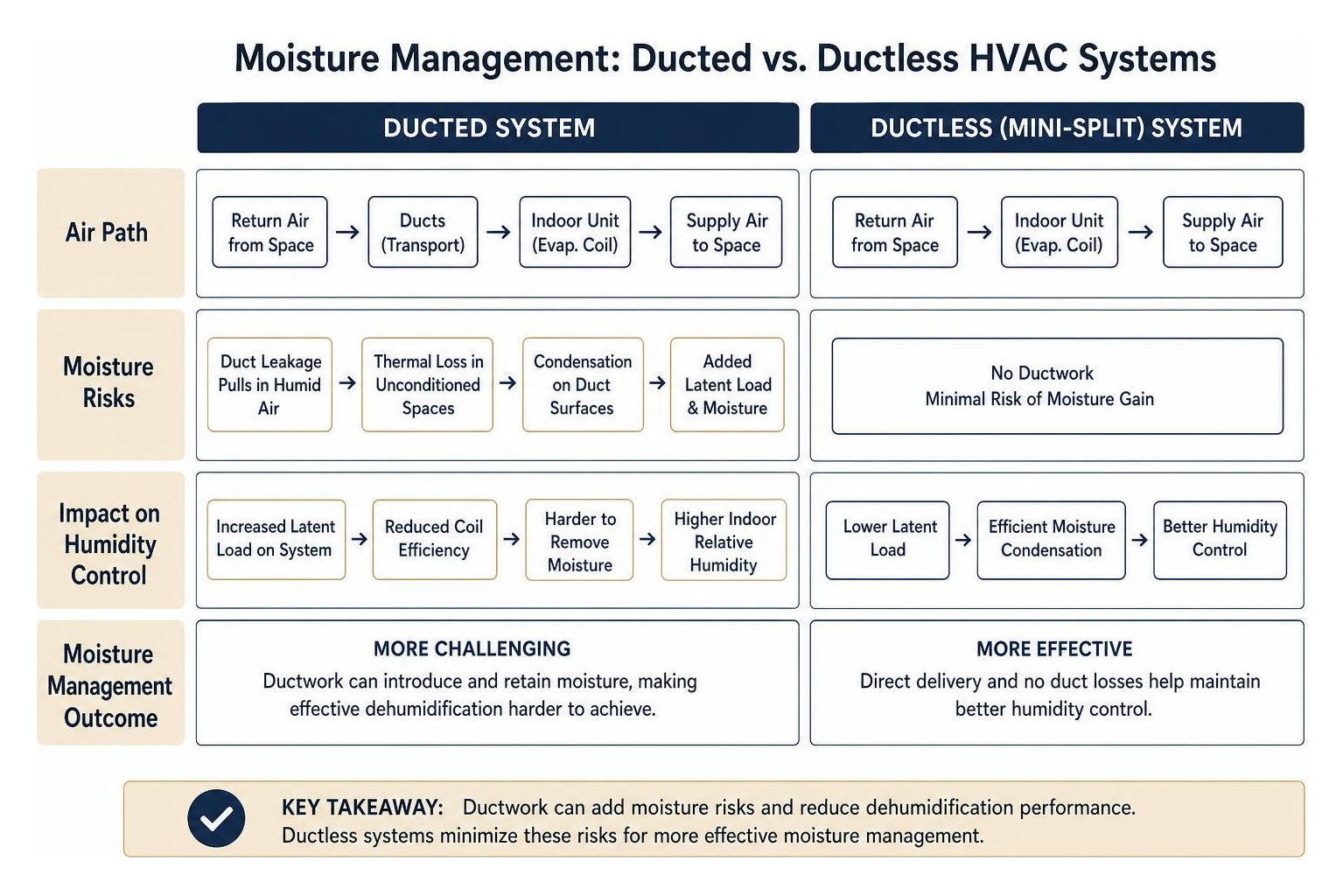
Duct leakage is a primary culprit. Studies indicate that duct losses in unconditioned spaces can account for 25-40% of energy loss. More critically, leaky ducts can pull humid, unconditioned air into the system, increasing the latent load the AC must handle. If ducts run through unconditioned attics or crawl spaces, this infiltration not only wastes energy but also introduces moisture directly into the conditioned air stream, making it harder for the system to dehumidify.
Static pressure, the resistance to airflow within the ductwork, also plays a critical role. Poorly designed duct systems with excessive bends, undersized ducts, or dirty filters can lead to high static pressure. This reduces airflow (CFM), which can decrease the system’s ability to move enough air across the coil to properly dehumidify and cool. Inadequate airflow can also lead to the evaporator coil getting too cold, potentially freezing over, or not cold enough to effectively condense moisture.
Thermal loss through uninsulated or poorly insulated ducts in unconditioned spaces can further exacerbate humidity issues. Cold ducts in a hot, humid attic can lead to condensation on the exterior of the ductwork, creating moisture problems in the attic itself and potentially leading to mold and structural damage.
Ductless mini-split systems, by their nature, avoid many of these duct-related challenges. They deliver conditioned air directly into the space, eliminating duct leakage and thermal losses associated with extensive ductwork. This direct delivery often allows for more precise control over individual room temperatures and humidity levels. However, even ductless systems require careful planning regarding their placement and sizing to ensure adequate air circulation and dehumidification throughout a zone. For comprehensive solutions that address both system performance and humidity control, exploring expert heat pump and mini-split services can offer valuable insights.
Airflow Dynamics and Building Pressurization
Optimal airflow is non-negotiable for effective AC performance and humidity control. For ducted systems, a general guideline is to aim for 350-425 CFM (cubic feet per minute) per ton of cooling capacity. However, in high-humidity environments, some experts might suggest slightly lower airflow rates to allow for more contact time between air and the cold coil, enhancing latent heat removal.
Beyond the system itself, building pressurization and envelope sealing are critical. In hot, humid climates, we generally aim for a slightly positive indoor pressure relative to the outdoors (between 0 and 0.03 inches water gauge). This positive pressure helps to prevent humid outdoor air from infiltrating the building through cracks and gaps in the building envelope. Uncontrolled air infiltration can introduce significant moisture loads, making it difficult for even a well-designed HVAC system to maintain comfortable humidity levels. Sealing the building envelope – including windows, doors, and penetrations – is a fundamental step in managing indoor humidity and reducing the workload on your AC system. This also reduces the risk of condensation on cold surfaces when warm, humid air infiltrates.

Planning Your Heat Pump and Mini-Split Installation for Maximum Efficiency
The journey to effective humidity control and energy efficiency begins long before installation, with meticulous planning. Proper sizing is paramount, and this starts with an accurate Manual J cooling load calculation. This detailed analysis considers factors like your home’s insulation, window types, orientation, internal heat gains, and local climate data to determine the precise heating and cooling requirements. Oversizing a system, a common mistake, leads to short-cycling – the unit turns on and off too frequently. While this might seem like it’s working hard, it actually reduces dehumidification because the evaporator coil doesn’t stay cold long enough to effectively condense moisture.
Modern heat pumps and mini-splits, especially those with variable-capacity compressors, excel in humid climates because they can modulate their output to precisely match the load. This allows for longer, continuous run times at lower capacities, which is ideal for latent heat removal. The extended cycle times ensure that the evaporator coil remains cold for longer, maximizing moisture extraction without overcooling the space. This continuous operation also contributes to a more stable indoor temperature and consistent comfort.

Key Factors in Heat Pump and Mini-Split Installation Sizing
Achieving optimal performance in high-humidity environments hinges on precise sizing. As mentioned, preventing short-cycling is crucial. A system that is too large will quickly satisfy the sensible cooling load (temperature reduction) and shut off, leaving excess moisture in the air. This leads to that “cold but clammy” feeling. The goal is to select a system that can run for extended periods, ideally with continuous low-speed operation, particularly when the sensible load is low but the latent load (humidity) is high.
This continuous, low-speed operation allows the system to maintain a favorable sensible heat ratio (SHR). A lower SHR indicates that a greater proportion of the system’s capacity is dedicated to removing latent heat. Variable-speed systems are adept at achieving this, effectively “wringing” moisture out of the air. By carefully matching the system’s capacity to the home’s actual cooling and dehumidification needs, we can ensure a proper indoor moisture balance, preventing both excessive dryness and uncomfortable humidity. This also means considering the specific conditions of your region; for instance, a home in coastal Louisiana will have different latent load requirements than one in a dry desert climate, even if both experience high temperatures.
Preparing Your Home for Heat Pump and Mini-Split Installation
Beyond the unit itself, the preparation of your home is vital for a successful installation that maximizes efficiency and humidity control. For mini-split systems, proper routing and insulation of refrigerant line sets are critical. These lines carry refrigerant between the outdoor condenser and indoor units, and if not insulated correctly, they can lose efficiency and even cause condensation issues.
Condensate drainage is another crucial element. All systems generate condensate, and it must be directed away from the unit and the building structure with a proper slope to prevent pooling, which can lead to mold and water damage. Double-sloped drain pans and non-corroding materials should be specified for air handling units.
For outdoor heat pump condensers, adequate clearance around the unit is necessary to ensure unrestricted airflow for optimal heat exchange. Blocked airflow can reduce efficiency and increase energy consumption. Finally, sealing all wall penetrations where refrigerant lines, condensate lines, and electrical conduits enter the home is essential to prevent air and moisture infiltration, maintaining the integrity of the building envelope.
Moisture Control and Condensation Prevention Strategies
Effective moisture control is a multi-faceted endeavor, especially when integrating HVAC systems in high-humidity climates. For ducted systems, duct insulation is paramount. Ducts running through unconditioned spaces, like attics, should have sufficient R-value insulation to keep the duct-jacket surfaces above the dew point of the surrounding air. This prevents external condensation, or “duct sweating,” which can lead to mold growth on the attic floor and structural damage. A vapor barrier integrated into the duct wrap is also essential to prevent moisture migration into the insulation itself. Experts often recommend locating ducts within conditioned spaces whenever possible to minimize these energy losses and condensation risks. Studies have shown that moving HVAC systems into conditioned space can save 4-5% source energy and reduce the HERS Index by around 4 points.
For both ducted and ductless systems, preventing microbial growth requires diligent attention to detail. This includes ensuring proper condensate drainage, using non-corroding materials for drain pans, and regularly inspecting and cleaning cooling coils and drip pans. Microbial growth in these areas can restrict airflow, reduce efficiency, and introduce unpleasant odors and allergens into the indoor air.
In some scenarios, particularly in extremely humid conditions or homes with high internal moisture loads, supplemental dehumidification might be necessary. However, if integrating a whole-house dehumidifier with a central AC system, the ducting configuration is critical. Research indicates that ducting a dehumidifier’s supply air into the central AC return upstream of the evaporator coil can decrease the AC’s latent performance by 28% and even cause re-evaporation of moisture from the coil when the AC cycles off. This can increase annual energy use by approximately 4%. Instead, ducting the dehumidifier independently or directly to the supply side is generally recommended, ensuring simultaneous operation for at least 15-20 minutes for optimal performance.
Feature / Performance Metric Ducted System (Well-Designed) Ductless Mini-Split System Latent Load Removal Excellent with variable-speed, long run times, and proper airflow. Excellent with variable-speed and “dry mode” settings, targeted control. Energy Efficiency High, especially with ducts in conditioned space and proper sealing. Very high, minimal distribution losses. Condensation Risk (Ducts) Moderate to high if ducts in unconditioned space, poorly insulated, or leaky. N/A (no ducts). Airflow Control Whole-home distribution, can be adjusted with dampers. Zone-specific, precise control. Building Pressurization Critical to manage infiltration, impacts whole home. Less direct impact on whole-home pressurization, but still relies on envelope. Installation Complexity Higher due to ductwork design, sizing, and sealing. Lower, but requires careful placement of indoor/outdoor units and line sets. Mold Risk Higher if ducts are leaky, uninsulated, or condensate not managed. Lower, but condensate management at indoor unit is crucial.
Frequently Asked Questions About Heat Pump and Mini-Split Installation
How do heat pumps handle high indoor humidity compared to traditional AC units?
Heat pumps, particularly modern variable-speed models, are generally far superior at handling high indoor humidity compared to traditional, single-speed AC units. This advantage stems from their ability to modulate their compressor and fan speeds. Unlike single-speed units that cycle on and off frequently, variable-speed heat pumps can run for longer durations at lower capacities. This extended, continuous operation allows the evaporator coil to remain cold for a longer period, maximizing the amount of moisture that condenses and drains away. This process, known as continuous latent heat removal, is essential for maintaining comfortable indoor relative humidity levels, often around 45-55%, without overcooling the space. Traditional ACs often short-cycle, satisfying the temperature setpoint quickly but leaving the air feeling clammy because insufficient moisture has been removed.
Can mini-splits run effectively in humid environments without supplemental dehumidifiers?
Many mini-split systems are designed with features that make them quite effective at managing humidity, often without the need for supplemental dehumidifiers. Their variable-speed technology allows for the extended, low-speed operation beneficial for dehumidification. Furthermore, many mini-splits include a “dry mode” setting. In this mode, the system prioritizes moisture removal by running the fan at a very low airflow velocity, allowing maximum contact time between the humid air and the cold evaporator coil, while only minimally cooling the room. This targeted room humidity control can be very effective for specific zones. However, in extremely humid climates or homes with unusually high internal moisture loads (e.g., from excessive showering, cooking, or indoor plants), a supplemental whole-house dehumidifier might still be beneficial for comprehensive moisture management, assuming it’s correctly integrated into the system to avoid performance degradation.
What installation practices prevent mold growth in ductless and ducted systems?
Preventing mold growth is a critical aspect of any HVAC installation, especially in humid environments. For ducted systems, key practices include specifying double-sloped drain pans made of non-corroding materials for air handling units, ensuring proper condensate line slope to facilitate continuous drainage, and thoroughly sealing and insulating all ductwork, particularly in unconditioned spaces. Ducts in unconditioned attics should have a minimum R-11 insulation to prevent external condensation. For both ducted and ductless systems, maintaining indoor surface relative humidity below 75-80% on building materials is crucial, as mold cannot grow below this threshold. This is achieved through proper system sizing, effective dehumidification, and good building envelope integrity to prevent humid air infiltration. Regular inspection and cleaning of cooling coils and drip pans are also essential to prevent microbial accumulation.
Conclusion
Navigating the complexities of HVAC installation in high-humidity environments demands a holistic approach that considers not just cooling, but comprehensive moisture management. From understanding the psychrometric principles that govern latent heat removal to meticulously planning duct design and system sizing, every decision impacts indoor comfort, energy efficiency, and long-term air quality. Modern heat pumps and mini-split systems, with their variable-speed capabilities, offer powerful tools for achieving these goals, but their potential can only be fully realized through expert installation practices. By prioritizing proper airflow, preventing duct leakage, ensuring adequate insulation, and implementing effective condensate management, we can create homes that are not only cool but also dry, healthy, and energy-efficient. Investing in thoughtful design and professional installation is the best way to ensure your system performs optimally, providing lasting comfort and peace of mind in even the most humid climates.


